18. SpaceNo. 18.36
Solar System
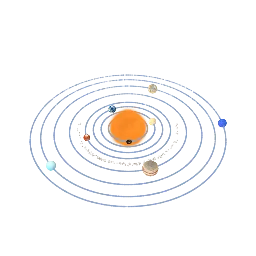
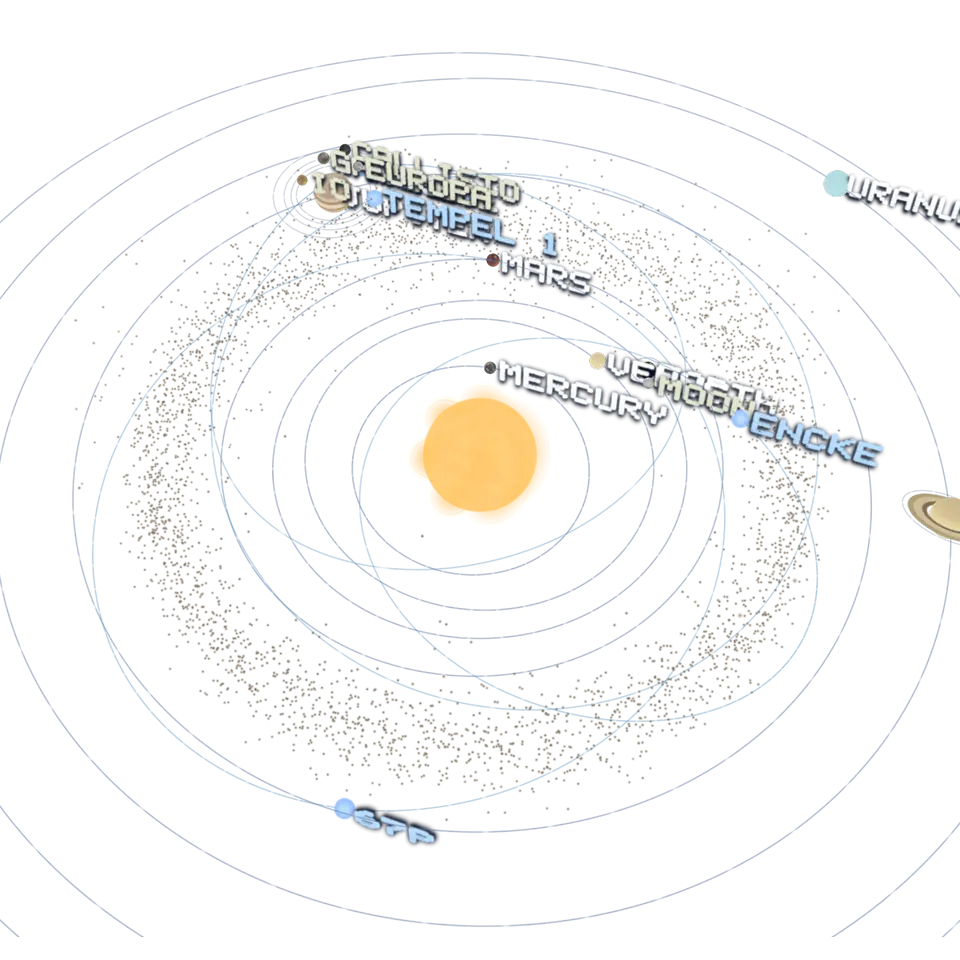
The Sun, the eight planets, six big moons, four famous comets and 4,000 real asteroids, each where its real orbit puts it on the date you pick, from 1800 to 2050.
Handling
Tap to fly to the next planet. Drag the date; set the speed and the scale in the Splash tab.
Its tag
- Shelf
- 18. Space
- Kind
- Built from a recipe
- Made from
- Positions from JPL's published orbital elements: the planets from E. M. Standish's Table 1 (1800 to 2050), the moons from JPL's satellite elements, and the comets and asteroids from the JPL Small-Body Database, each moved by Kepler's laws. The readable scale is not to scale (it says how).
- Sound
- Yes
- Licenses
- Public domain
On the wall it weighs 6.0 KB: 506 splats, fitted to pictures of the full Splash, which opens with 104,393.
Its controls
| Control | Kind | Range | Start |
|---|---|---|---|
| Fly to the next planet | Tap | ||
| Speed | Slider | 0 to 100% | 72% |
| Fly to the next planet | Button | ||
| Scale | List | 2 choices | Readable scale (not to scale) |
| Names | Setting |
About it
The Sun, the eight planets, six big moons, four famous comets and 4,000 real asteroids, each where its real orbit puts it on the date you pick, from 1800 to 2050. The orbits come from JPL's published elements, and every body moves by Kepler's laws, faster near the Sun. The asteroids are a random sample of the cataloged ones: the main belt between Mars and Jupiter, and the Trojans that share Jupiter's orbit, 60 degrees ahead and behind.
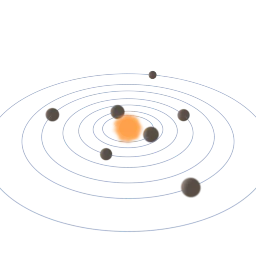
The readable scale is not to scale: distances from the Sun are squeezed and the planets drawn hundreds of times larger, so everything fits. Pick the true scale to see how empty space is: the planets shrink to specks. A comet's tail always points away from the Sun; its length is a picture.
Details
- Splats
- Opens at 104,393 at Mid Detail, 47,571 at Low, and up to 104,393 at Max
Is it right?
The Sun, the eight planets, six large moons, four comets and 4,000 real asteroids, each placed for the chosen date from published JPL orbital elements and moved by Kepler's laws. Against JPL Horizons the planets are within 0.2 degrees from 1850 to 2049, the moons within about 6 degrees, and the asteroids and comets within hundredths of a degree near the snapshot's date, drifting to a degree or two over decades because the planets' pulls on them are left out. The readable scale squeezes distances and enlarges the bodies, and says so; the comets' tails are a picture.
Close
The planets are placed by JPL's Keplerian elements for 1800 to 2050.12
Table 1's elements and their rates per century give each orbit for the date; Kepler's equation gives the heliocentric position in the J2000 ecliptic (the night sky's code, src/sky/astro.js). The Earth is the Earth-Moon barycenter.
Simplified
Asteroids and comets move on their own orbits by Kepler's laws, from the JPL Small-Body Database's elements.32
Each body's osculating elements (a, e, i, node, argument of perihelion, mean anomaly at an epoch) are carried to the date by the two-body problem: the mean anomaly grows at n = k / a^1.5 (k the Gaussian constant) and Kepler's equation gives the place.
Correct
The asteroids are an honest sample of the real catalog.3
A seeded uniform random sample of 4,000 of the 894,648 numbered asteroids whose orbits' semi-major axes are under 5.6 au (99.9% of the 895,910 numbered ones), plus Ceres, Pallas, Vesta and Hygiea, the largest four. Nothing is placed by hand: the Kirkwood gaps, the Hildas and the Trojans 60 degrees ahead of and behind Jupiter show because they are in the catalog.
Close
The asteroids move along their orbits on the graphics chip, by the same Kepler step.45
Each asteroid splat stores its place at the snapshot's epoch, its semi-major axis and its velocity's direction (12-bit). Every frame the GPU program recovers its speed by the vis-viva law, the orbit's shape from its place and velocity, and solves Kepler's equation for the date.
Close
The Moon, Jupiter's four large moons and Titan are where JPL's satellite elements put them.62
Mean elements at J2000 with the apsis and node turning at their listed periods, in each planet's Laplace plane (the Moon's in the ecliptic). The Moon's period is sidereal; Io's and Europa's periapses regress (the Laplace resonance holds them), so their apsis periods run backward. Titan uses its Horizons osculating elements of October 7, 2026 at the table's mean period.
Correct
The date runs from 1800 to 2050, and the speed from paused to a year each second.1
The date slider over the stage spans January 1, 1800 to December 31, 2050, the years Table 1 is made for; the Speed slider runs from paused through an hour a second to 365.25 days a second.
- 1Approximate Positions of the Planets (E. M. Standish), Table 1, JPL Solar System Dynamics
- 2Horizons System, JPL Solar System Dynamics
- 3SBDB Query API and SBDB API, JPL Solar System Dynamics
- 4Eccentricity vector, Wikipedia
- 5Vis-viva equation, Wikipedia
- 6Planetary Satellite Mean Elements, JPL Solar System Dynamics
- Simplified
- The readable scale is not to scale: each distance from the Sun is drawn as ln(1 + r / 0.25 au), so the inner planets spread out (directions stay true); the planets and moons are drawn hundreds of times larger (their sizes go as the 0.4th power of the real ones), the Sun smaller in proportion, and the moons closer to their planets. The legend says which scale is on.
- Simplified
- The true scale draws distances and sizes on one scale; the planets are then far smaller than a pixel from the whole view (each shows as a speck), and a fly to one zooms in up to about a thousand times.
- Simplified
- The orbit lines are drawn for the snapshot's date; the planets' orbits turn slowly (Mercury's perihelion moves about half a degree in 250 years), so far from 2026 a planet sits a hair off its line.
- Simplified
- The planets' spins and their seasons' tilts are not shown; Jupiter's, Saturn's, Uranus's and Neptune's colors are bands by latitude, not maps, and Venus is drawn as its cloud tops in one color.
- Simplified
- A comet's tail points away from the Sun, as real tails do, but its length (growing inside about 5 au) and look are a picture.
- Simplified
- The asteroids, comets and moons feel only their primary's pull (the two-body problem), so they drift from their real places over decades; the planets' Table 1 already folds in the planets' long-term changes.
Sources and credits
| Work | By | License |
|---|---|---|
| Approximate Positions of the Planets (E. M. Standish), Table 1 | JPL Solar System Dynamics | Public domain (NASA/JPL) |
| Planetary Satellite Mean Elements; JPL Horizons (Titan) | JPL Solar System Dynamics | Public domain (NASA/JPL) |
| JPL Small-Body Database (a snapshot of October 7, 2026) | JPL Solar System Dynamics | Public domain (NASA/JPL) |
| The color maps of the real worlds (Space r2), shrunk | NASA, USGS (see the real worlds' credits) | Public domain |